
A Better Fender Cover Starts Before the Neoprene Is Cut
Most boat owners see the finished product: a custom fender cover carrying a boat name, yacht logo, marina brand, or original artwork. What they do not see is the pattern engineering that determines whether that cover will actually fit the fender.
Flexifabrics does not begin with a generic fabric tube and ask it to stretch across several unrelated fenders. We begin with the exact manufacturer, product family, model, and size. Then we select the matching proprietary dieline created for that specific shape. That is the difference between a true custom boat fender cover and a one-size-fits-all sleeve.
What Is a Boat Fender Dieline?
A dieline is the production pattern used to cut flat material before it is stitched into a three-dimensional cover. It defines every panel, curve, seam allowance, fold line, match point, and drawstring opening. For a cylindrical fender, tapered buoy, flat fender, or inflatable yacht fender, those details are different.
A few fractions of an inch can determine whether the finished FenderSox™ cover follows the body cleanly or develops loose areas that bunch, rotate, or sag. Our dielines account for the geometry of each real fender rather than assuming that products with similar advertised dimensions have identical shapes.
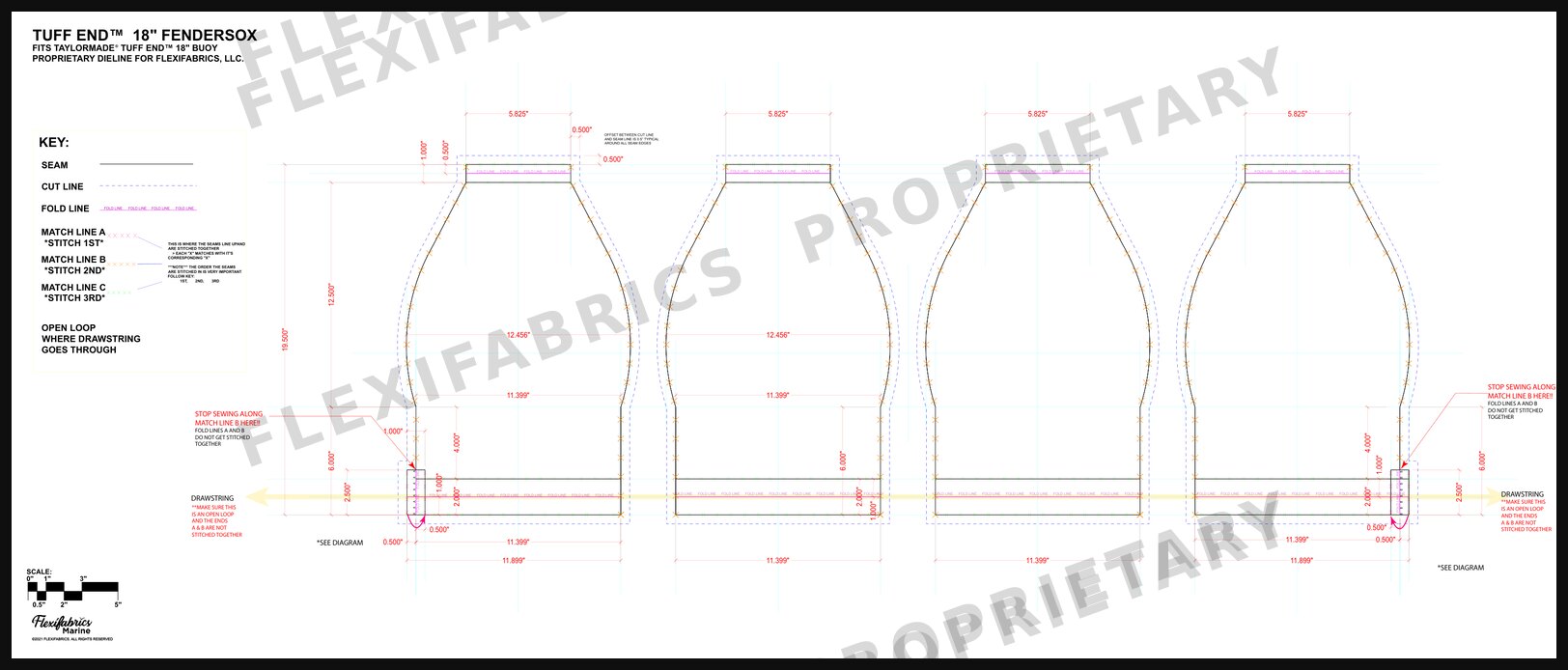
From the Physical Fender to a Production-Ready Pattern
Step 1
Identify the Exact Fender
We confirm the brand, model, and size—not simply a rough diameter and length. Taylor Made, Polyform, Big Bumper Company, and other manufacturers use different proportions, end shapes, eye designs, and tapers across their ranges.
Step 2
Map the Three-Dimensional Geometry
The physical fender is measured and translated into flat panels. Curves, taper, circumference changes, end caps, reinforced eyes, and closure locations all affect the final pattern.
Step 3
Engineer for 5mm Neoprene
Material thickness and stretch behavior matter. Our patterns are designed around premium 5mm wetsuit-grade neoprene, not thin sock fabric. The result balances a tailored appearance with the controlled stretch needed for installation and movement at the dock.
Step 4
Preserve the Pattern in Our Dieline Library
Once approved, the model-specific dieline becomes part of our proprietary production library. Future orders for that exact fender start with a proven pattern instead of guesswork.
Why One-Size-Fits-All Covers Fall Short
Universal covers are designed around a size range. That sounds convenient, but it transfers the compromise to the boat owner. Excess fabric can gather near the ends, seams may rotate out of position, and a loose cover can move every time the fender rolls against the hull or dock.
- —Different shapes need different panels. A tapered buoy cannot be covered correctly with the same pattern used for a straight cylindrical fender.
- —Fit affects presentation. Precision paneling keeps custom graphics, names, and logos aligned instead of allowing them to twist away from view.
- —Controlled coverage protects the boat. A stable neoprene surface creates a more consistent contact layer between the fender and gelcoat.
For a deeper comparison, read our guide to custom-fit versus universal boat fender covers.
The Library Keeps Growing
The Flexifabrics dieline library now contains hundreds of model-specific production patterns spanning the major boat fender brands and product families on the market. We continue to update it as manufacturers release new products and as customers bring us less common fenders.
If you are unsure what you own, use our boat fender size and identification guide. If your exact model is not yet in the library, send us the details. Precision starts with identifying the real fender—not forcing it into the nearest generic category.
Engineered for your exact fender
Get a Precision-Fit 5mm Neoprene FenderSox™ Cover
Tell us the brand, model, and size. We will match it to the correct proprietary dieline and create your free custom design mockup.
Start Your Custom Request